

For sales that happen after the landing page
Consulting, training and service businesses often close through a conversation. Someone can submit a form today, speak to your team next week and pay after a follow-up. Lead volume alone cannot describe that ad's outcome.
WhoBuys brings together available spend, lead origin and payment data. Calls add context: the need, objection, quoted offer or agreed next step. They do not replace payment evidence.
Trace the journey from ad to payment
Start with a lead whose source can be documented. Then reconcile records for the same person across tools. A shared email helps; a first name alone does not resolve an ambiguous match.
- Ad: identify the campaign and, when supported by the source, the exact creative.
- Lead: preserve identifiers and contact details needed for reconciliation.
- Call: inspect available excerpts and separate the offer from the buyer's decision.
- Payment: inspect money received and associated refunds, without treating future instalments as collected cash.
Compare ads by their buyers, not just their leads
A low cost per lead may hide prospects who do not buy. Another ad may generate fewer bookings but more buyers. WhoBuys lets you examine the people and payments behind totals before making a decision.
A handful of sales does not establish a lasting winner. Check the reporting window, time to payment and proportion of unknown origins. Attribution describes an observable connection; it does not prove that an ad alone caused the sale.
Start with one real journey
Setup is assisted. We check your lead sources, payments and optional call tool, then validate a complete test journey. Meta access depends on granted permissions and records available to your account. We also check synchronization dates before interpreting results.
If an approximate name is the only link between a prospect and a payment, collection or matching needs attention first. WhoBuys cannot reconstruct a source that was never captured.
Analyse purchase motivations without confusing the prospect and the closer
A sales rep's argument is not a motivation expressed by a prospect. Start with the prospect's quote, locate the passage in the call and verify who is speaking. If the speaker or meaning is uncertain, do not treat the signal as evidence.
Separate spontaneous statements from answers prompted by a question. A quote records what one person said at that moment; it establishes neither a trait shared by all buyers nor the cause of a purchase. Payment evidence comes from payment records, not the call summary.
- Compare buyers' and non-buyers' words over the same period.
- Keep quotes in context, including cases that contradict a hypothesis.
- Turn recurring needs into ad angles to test, without promising better sales.
An annotated walkthrough: evidence and hypotheses
This screenshot of the WhoBuys website was captured on 26 October 2026. Camille, the ad and the €3,000 are fictional. This is a demonstration, not a customer testimonial or an observed campaign result.
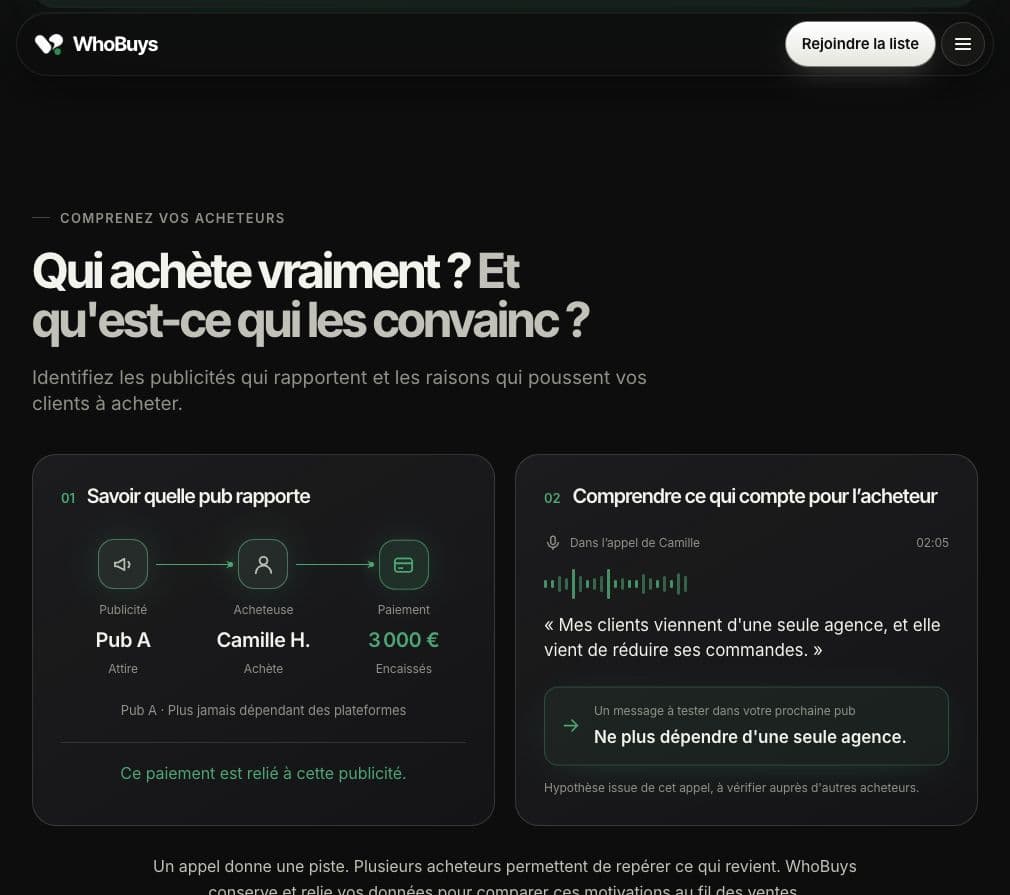
- 01. Origin and payment are separate pieces of evidence to check. The amount alone says nothing about ad spend or profit.
- 02. The quote describes dependence on one agency. Becoming independent is a potential message to test, not an additional fact stated by the buyer.
- Limit: no acquisition period, observation window or comparison group is provided here. This illustration cannot establish ROAS or a performance improvement.